









Feb . 28, 2026
Reactive intermediates are short-lived, high-energy species formed during chemical reactions. They are crucial for understanding reaction mechanisms and predicting reaction outcomes in organic synthesis. These intermediates, while rarely isolated directly, play a vital role in transforming reactants into products. Their understanding is paramount for chemists in a variety of fields, including pharmaceuticals, materials science, and industrial chemistry. Exploring their structure, how they form, and their reaction patterns is key to mastering organic chemistry.
Unlike stable molecules, reactive intermediates possess incomplete valence shells and, therefore, are highly reactive. They exist for a fleeting moment, typically fractions of a second, before reacting further to form a more stable product. These intermediates are often invoked to explain observed reaction kinetics and stereochemistry. Common types include carbocations, carbanions, free radicals, carbenes, and nitrenes. The energy profiles of reactions frequently involve transition states leading to these intermediates, defining the activation energy and reaction rate. Studying these intermediates allows for rational design of reactions to enhance yields and control selectivity.
Several classes of reactive intermediates are commonly encountered. Carbocations are positively charged carbon species, often formed through heterolytic cleavage of bonds. Carbanions are the negatively charged counterparts, resulting from the removal of a proton or electron-withdrawing group. Free radicals possess unpaired electrons and are highly reactive, often initiating chain reactions. Carbenes, featuring a neutral carbon with only six electrons, are versatile intermediates used in cyclopropanation reactions. Nitrenes, analogous to carbenes but containing a nitrogen atom, also participate in unique transformations. Understanding the electronic structure and stability of each intermediate dictates its reactivity.
Key Intermediate Characteristics: These species are inherently unstable due to incomplete octets or charge separation. They are rarely directly observed and are inferred through mechanistic studies. Their reactivity is dictated by their electronic structure and the surrounding environment.
Carbocations are formed via heterolytic cleavage, leaving a positive charge on carbon. Their stability follows the order: tertiary > secondary > primary > methyl. Resonance stabilization and inductive effects further influence stability. Common reactions involving carbocations include SN1 reactions, E1 reactions, and rearrangements. Rearrangements, such as hydride and alkyl shifts, occur to generate more stable carbocations. For example, in the dehydration of alcohols, carbocation rearrangements are common. These mechanistic pathways are crucial in understanding the products formed. The careful control of carbocation-mediated reactions is often essential in chemical manufacturing.
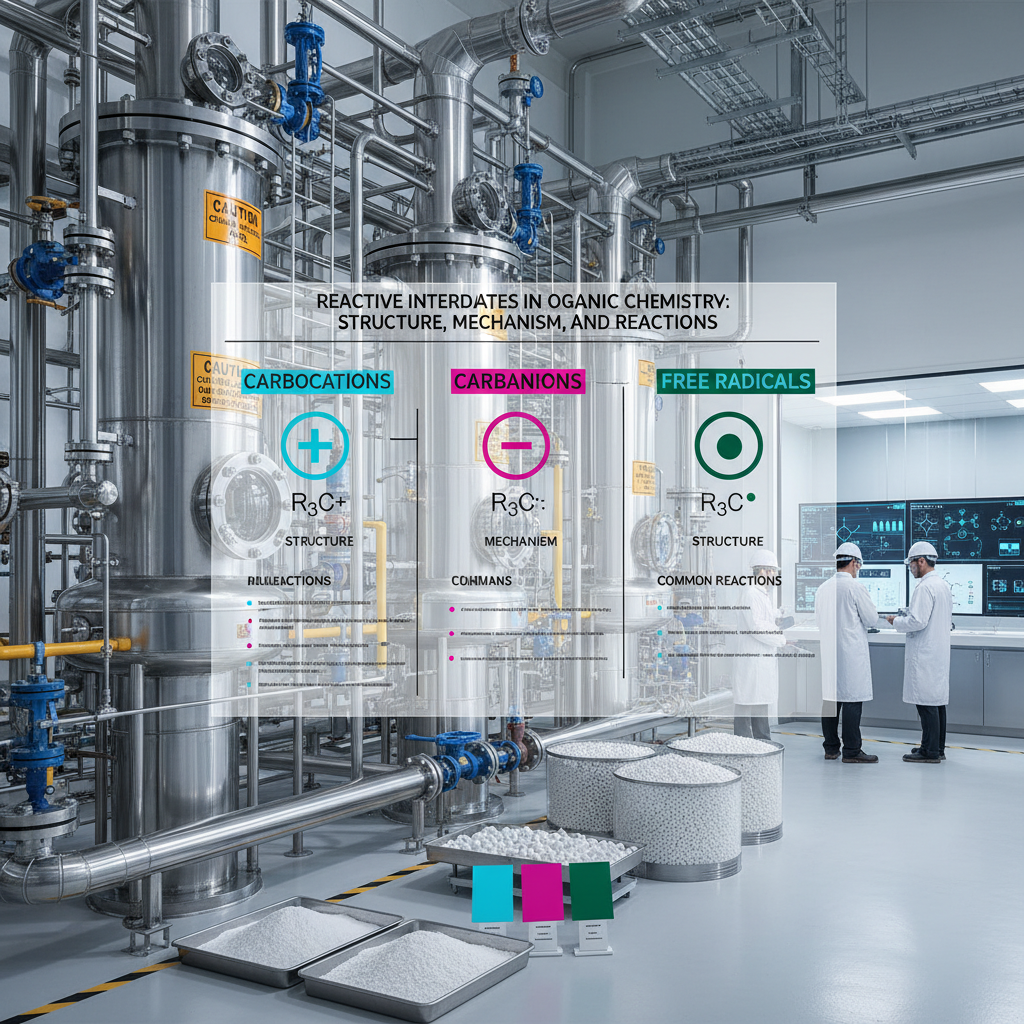
Understanding the relative stability of these intermediates is critical for predicting reaction pathways. Carbocation stability is governed by inductive and hyperconjugative effects. Carbanion stability is enhanced by electron-withdrawing groups and resonance. Free radicals are stabilized by delocalization of the unpaired electron. Here’s a comparison:
A thorough understanding of reactive intermediates is critical in designing efficient and selective industrial processes. For example, optimizing polymerization reactions relies on controlling free radical intermediates. Similarly, the production of fine chemicals and pharmaceuticals often involves reactions proceeding through carbocation or carbanion intermediates. Precise control of reaction conditions, including temperature, solvent, and catalysts, allows for maximizing product yield and minimizing unwanted byproducts. HBGX Chemical provides high-quality reagents and catalysts to support these complex chemical processes.
Reactive intermediates, while transient, are the cornerstone of understanding organic reaction mechanisms. Their study is essential for chemists seeking to design, optimize, and control chemical transformations. By grasping the principles governing their formation, structure, and reactivity, researchers and industrialists can unlock new possibilities in chemical synthesis and materials science.
Direct observation of reactive intermediates is challenging due to their short lifetimes. However, several techniques can provide evidence for their existence. Kinetic studies can infer the involvement of an intermediate based on the reaction rate law. Trapping experiments involve introducing a reagent that reacts rapidly with the intermediate to form a stable product. Spectroscopic techniques, such as electron spin resonance (ESR) for free radicals and UV-Vis spectroscopy for carbocations, can sometimes detect intermediates directly. Computational chemistry also provides valuable insights into the structures and energies of these species.
Solvents play a crucial role in stabilizing or destabilizing reactive intermediates. Polar solvents can stabilize charged intermediates, such as carbocations and carbanions, through solvation. Protic solvents can hydrogen bond to intermediates, affecting their reactivity. Aprotic solvents are preferred for reactions involving strong bases to avoid protonation. The solvent's ability to participate in reactions, such as SN1 or SN2, also influences the outcome. The choice of solvent is, therefore, a key consideration in reaction design.
Catalysts accelerate reactions by lowering the activation energy, often by stabilizing the transition state leading to a reactive intermediate. For example, acid catalysts can protonate reactants, facilitating carbocation formation. Metal catalysts can coordinate with reactants, forming intermediates that enable unique transformations. Phase-transfer catalysts enhance the reactivity of ions in heterogeneous systems. The choice of catalyst is crucial for controlling the selectivity and rate of a reaction. HBGX Chemical provides a variety of catalysts for organic reactions.
Calcium Zinc Stabilizer For Reliable PVC Production


 English
  Arabic
  Belarusian
  Bengali
  Bulgarian
  Finnish
  French
  German
  Hebrew
  Hindi
Hindi  Hungarian
  Indonesian
  Italian
  Japanese
  Korean
  Persian
  Portuguese
  Russian
  Spanish
  Turkish